
Sports Betting & Live Betting
Favorite losing: how often do they still win? The BetClutch numbers
When the favorite loses the first set or falls behind, do they come back? Over three weeks of matches followed by BetClutch, we counted, sport by sport, and compared the outcome with what the odds said.
4 min read

On 5 October in Tokyo, Carlos Alcaraz lost the first set to Jaume Munar. His odds went from 1.10 to 1.80, and he won the next two sets. That is the kind of match people remember. But is it the rule? We counted.
What we measured
Every time the favorite falls behind, BetClutch sends an alert with the odds at that instant. We took every one of those alerts on matches finished between 25 September and 12 October 2026, and looked at who won in the end.
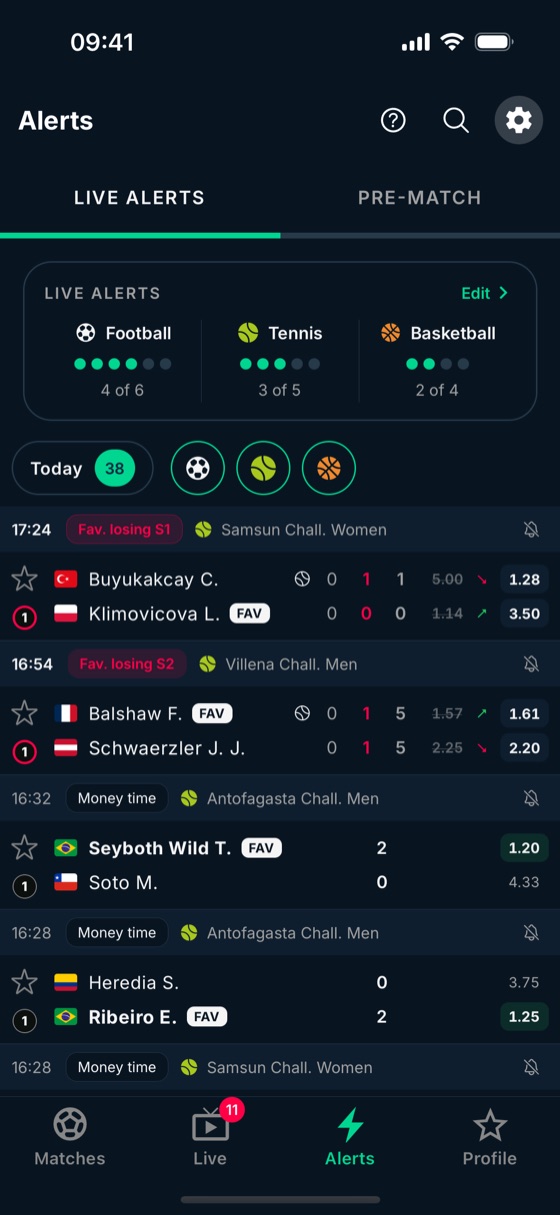
- 480 matches of tennis, basketball and football.
- Retirements and doubles left out.
- The favorite is the side the odds named before the match: at most 1.80 in football, under 1.60 in tennis and basketball.
- The "probability from the odds" is the one the odds implied at the moment of the alert, with the bookmaker's margin removed.
Tennis: the favorite loses the first set
Over 198 matches, the favorite who lost the first set went on to win 65 times, or 33%. At the moment of the alert their odds were around 2.50 (median), and the odds gave them 40% on average.
So Alcaraz is not the rule: two times out of three, the favorite who loses the first set loses the match.
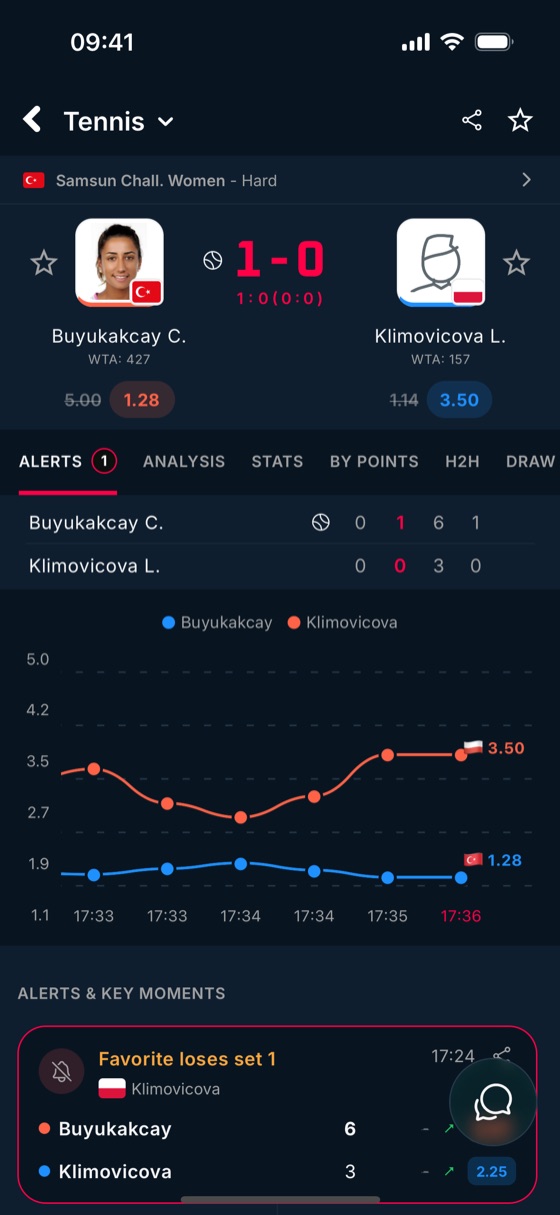
How big the favorite was changes everything:
- Heavy favorite, under 1.20 at the first serve: 20 wins in 28 matches, or 71%. The odds at the alert said 56%.
- Favorite between 1.20 and 1.39: 20 wins in 62, or 32%. The odds said 43%.
- Favorite between 1.40 and 1.59: 25 wins in 108, or 23%. The odds said 34%.
A heavy favorite who drops a set is still a much better player: over this period, they came back more often than their odds said. A slight favorite is often beaten for good. With only 28 matches in the first group, that figure needs a longer period to be confirmed.
The favorite loses the second set (most often after winning the first, so at one set all): over 100 matches, they won 56% of the time, against 59% from the odds.
Basketball: the favorite is behind
- Behind after the 1st quarter: the favorite won 53% of 57 matches, against 54% from the odds.
- Behind at half-time: 45% of 53 matches, against 42%.
- Behind after the 3rd quarter: 36% of 42 matches, against 36%.
In basketball, the live odds were right: at every stage, the share of wins is very close to what they implied.
Football: the favorite concedes and falls behind
Over 40 matches, the trailing favorite won 12 times (30%), drew 13 times (33%) and lost 15 times (37%). The odds gave them a 32% chance of winning. The other football alerts (two goals down, behind at the 70th minute) have fewer than 20 matches each: too few to say anything.
What to take from it
- Live odds are mostly right. In basketball and football, the trailing favorite wins about as often as the odds imply. Odds going up are not a bargain in themselves.
- In tennis, the favorite who lost the first set won a little less often than their odds said (33% against 40%). The gap is at the edge of the margin of error, about 7 points over 198 matches.
- Except heavy favorites, who came back 7 times out of 10 when their odds said just over half the time. That is where the value was over this period, and it is the Alcaraz v Munar case.
These numbers do not tell you what to bet, and three weeks of matches, mostly Challenger tournaments, do not make a law. They tell you what happened, and what the odds were worth at that instant. We will update them every month.
Get the alert at the right time
BetClutch sends the favorite losing alert the moment the match turns, with the live odds: in tennis, basketball and football. You choose which alerts you receive and which competitions you follow. See favorite losing alerts.
BetClutch is an information and analysis app for adults only. It takes no bets and gives no betting advice. Bet responsibly.