Sports Betting & Live Betting
Sports trading: take the odds before they move, and what the numbers say
Sports trading means taking a price before it moves, then making the most of the movement: keep a bet that pays more than the market, or hedge it to lock in a profit. The maths step by step, and what odds really do before kick-off, across 694 matches followed by BetClutch.
5 min read
You see it on social media: a price taken early in the week, sliding down until the match, then a table showing the same profit on every outcome. "Guaranteed profit before the match, whatever the result." That is sports trading: taking a price before it moves, then making the most of the movement. Here is how it works, what it really pays, and what odds do before kick-off.
The idea: take the price before it moves
A tennis match opens early in the week. Player A is at 2.10, player B at 1.75. You back A: 100 at 2.10.
Over the next few days, the market changes its mind. Before the match, A is at 1.75 and B at 2.15. Your ticket stays at 2.10: you hold a price the market no longer offers.
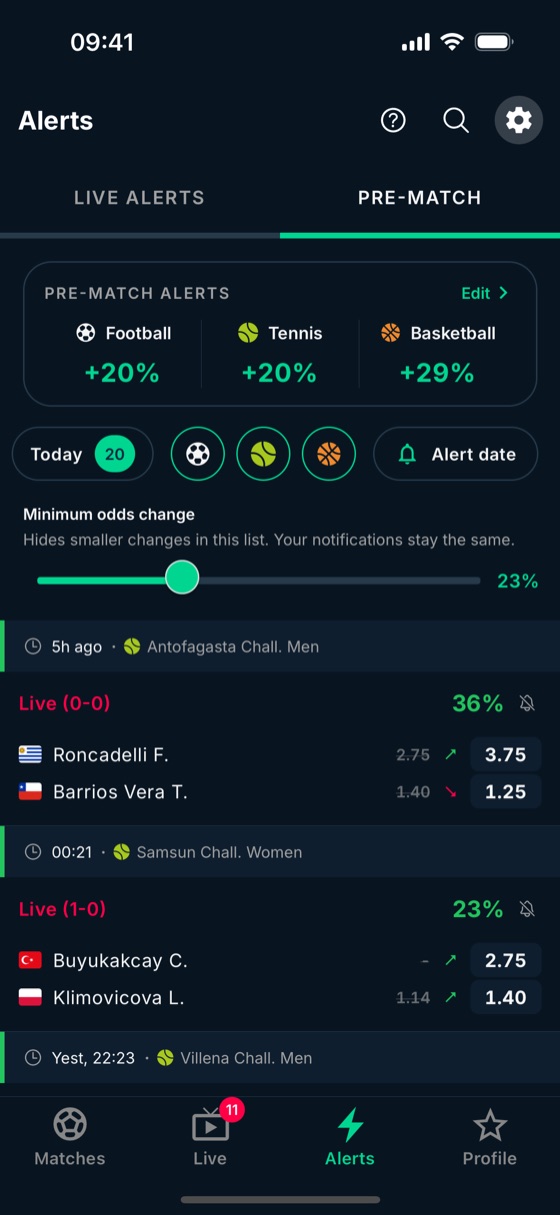
This is where the odds movement alert comes in: BetClutch compares the opening odds with the current odds and tells you as soon as the gap passes your threshold. You see the move when it happens, without watching the price yourself.
You then have two options.
Option 1: keep the bet
You let your bet at 2.10 run. If A wins, you collect 210, where someone betting at kick-off would only have got 175 for the same stake. You have a better price than the closing market, but the result is still uncertain: if A loses, you lose 100.
Option 2: hedge to lock in a profit
You bet on the opposite outcome, B, at its new price of 2.15, at a regular bookmaker. The right stake: 100 × 2.10 / 2.15 = 97.67.
- If A wins: +110 on the first bet, −97.67 on the second. +12.33.
- If B wins: −100 on the first, +112.33 on the second. +12.33.
The profit is the same whatever the result: that is the "guaranteed profit". In football, with three outcomes, you hedge the draw and the other team the same way. Many bookmakers also offer cash out, which does the same thing in one tap, for a margin. On a betting exchange, where you can bet against A, the profit would have been closer to 20, minus commission.
The other way
Same bet, 100 on A at 2.10. But this time, A's price rises to 2.50 and B's falls to 1.57. To hedge, you have to stake 133.76 on B.
- If A wins: +110 − 133.76 = −23.76.
- If B wins: −100 + 76.24 = −23.76.
The loss is "guaranteed" too. The profit is only locked in once the price has moved the right way, and the bookmaker's margin makes hedging more expensive one way than the other. So the real question is: which way do odds move before a match?
What odds do before kick-off
We took the matches finished from 29 September to 12 October 2026 followed by BetClutch, with two prices from the bookmaker bet365: at the market opening (at least 12 hours before the match) and the last one before kick-off.
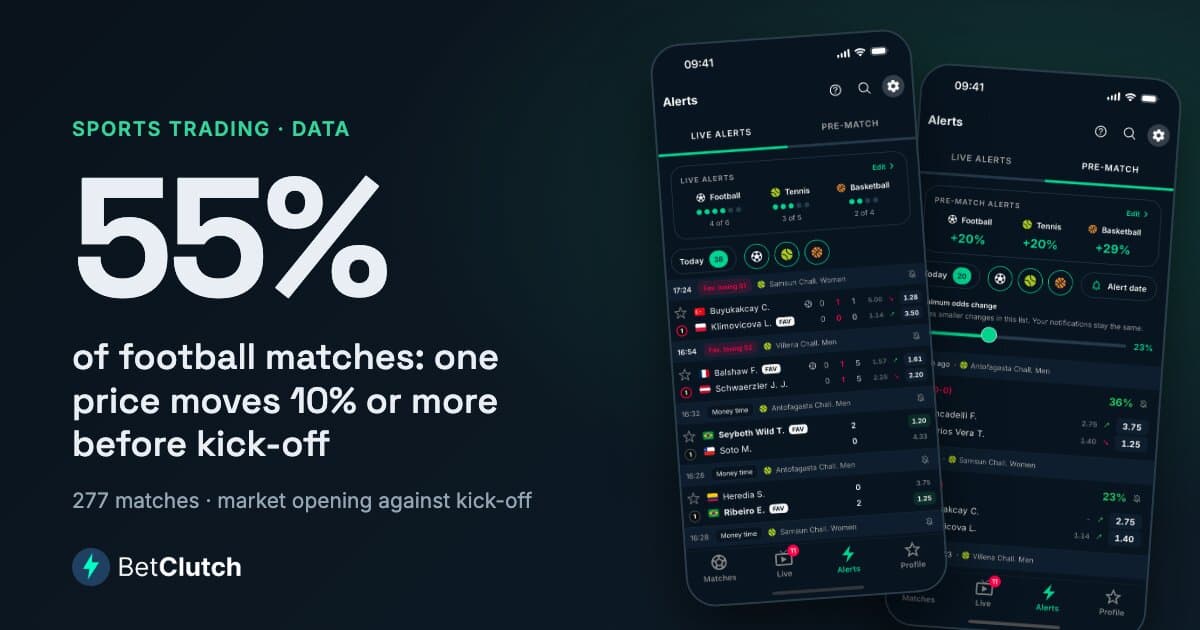
- Football, 277 matches: in 55% of matches, one of the three prices moved by at least 10%; in 20%, by at least 20%. The favourite switched sides in 8% of matches.
- Tennis, 328 matches: one price moved by at least 10% in 34% of matches, by at least 20% in 8%.
- Basketball, 89 matches: at least 10% in 54% of matches, at least 20% in 29%.
So odds move often: there is plenty for a trader to work with. But they do not mostly move the helpful way: in football, one price in five rose by at least 10% before the match, one in eleven fell by as much. In tennis, 13% rose and 7% fell; in basketball, 24% and 16%. Taking a price at random at the opening is not enough.
Do dropping odds point to the winner?
That is the other common idea: if the odds drop, "the money knows". In our matches:
- Selections whose odds fell by at least 10% won 33% of the time (153 selections). Their opening odds said 32%, their kick-off odds 38%.
- Selections whose odds rose by at least 10% won 30% of the time (287 selections). The opening odds said 33%, the kick-off odds 29%.
Over this period, kick-off odds were no more accurate than opening odds: dropping odds did not point to the winner. So trading is not about following the move and hoping for the right result, but about making the most of the price gap itself. Two weeks of matches is short; we will measure it again.
What to take from it
- Sports trading is about timing. A price taken before it drops is worth more than the kick-off price; the odds movement alert tells you when the gap appears.
- Two ways to make the most of it: keep a bet that pays more than the market, or hedge it to lock in a profit, at a regular bookmaker, with cash out or on a betting exchange.
- The profit is only guaranteed after the move. If the price goes the other way, hedging locks in a loss, and in football prices rise more often than they fall.
- Dropping odds do not point to the winner in our matches: selections whose odds fell won about as often as their opening odds said.
Follow odds movements with BetClutch
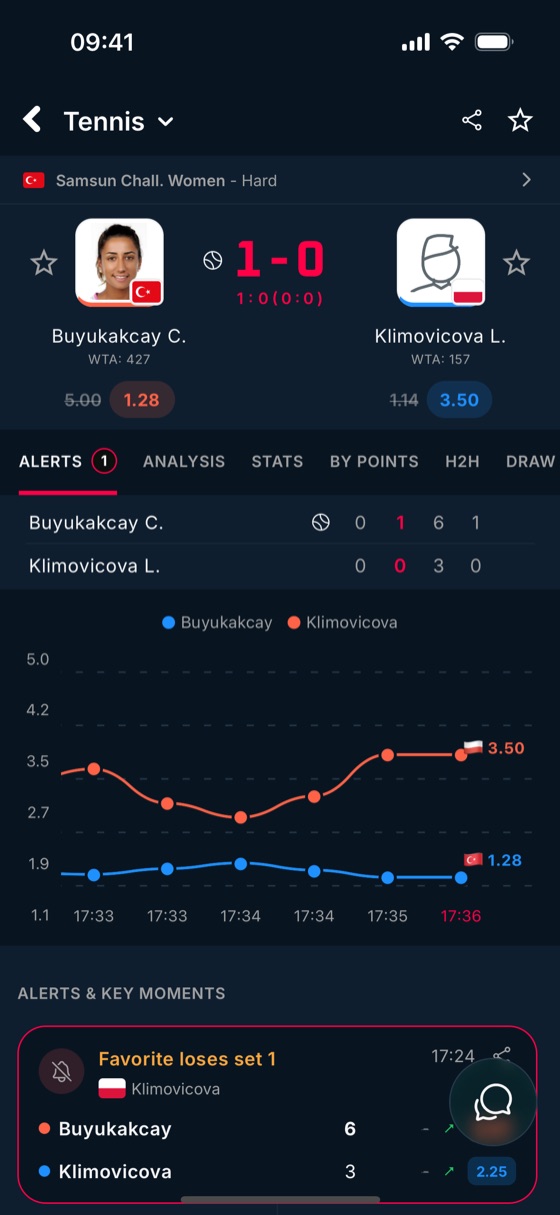
BetClutch keeps the opening odds of every football, tennis and basketball match, compares them with the current odds and sends you odds alerts when the gap passes the threshold you choose, sport by sport. Each match's chart shows how the odds moved before and during the game. See dropping odds.
BetClutch is an information and analysis app for adults only. It takes no bets and gives no betting advice. Bet responsibly.